Why do scuba divers fall backwards off boats? Because it’s the safest, most efficient way to enter the water from a small vessel while wearing 30–40 lbs of gear. The backward roll, sometimes called the “back roll entry”, uses gravity naturally, protects the diver’s face and mask from impact, and keeps small boats from rocking dangerously. And yes, the joke answer works too: if they fell forward, they’d still be in the boat.
Every first-time diver notices it. You’re watching experienced divers on a small boat in Cozumel, and one by one they sit on the edge, tuck their chin, and disappear backwards into the Caribbean. It looks almost theatrical. But there’s real science, real safety logic, and a surprisingly elegant bit of physics behind every single backward roll. Let’s break it all down.
The Quick Answer
“Why do scuba divers fall backwards off the boat?”
“Because if they fell forward, they’d still be in the boat.”
The oldest joke in diving. Also technically accurate.
That joke is funnier once you understand why it’s true. On a small dive boat, whether it’s a Mexican panga, a Zodiac, or a rigid inflatable boat (RIB), the diver sits on the gunwale (the outer edge of the boat) facing inward. Falling forward means falling back onto the deck. Falling backward means entering the water. The joke captures the geometry perfectly.
But “falling” is the wrong word. A properly executed back roll is a controlled rotation, not a tumble. Here’s the real reason it became the standard technique worldwide.
Why Not Fall Forward?
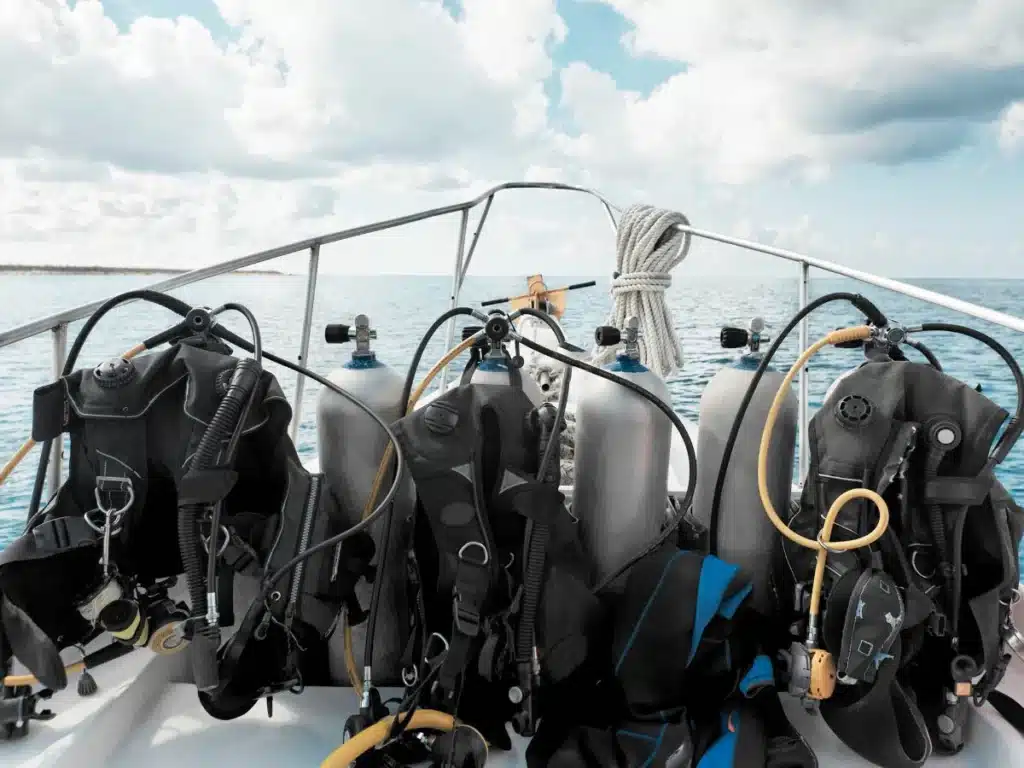
Falling forward, or jumping feet-first off the side, sounds intuitive until you factor in what a diver is wearing. A scuba tank alone weighs 30–40 lbs. Add a BCD (buoyancy compensator device), regulator, fins, and a wetsuit, and you’re carrying close to 50 lbs of equipment. Standing upright on a rocking boat with long fins on your feet and that much weight on your back is genuinely difficult. Walking toward the edge and jumping forward puts all that momentum toward the boat’s hull, which is exactly what you don’t want.
The Physics Behind the Backward Roll Entry
It’s All About the Tank (And Your Center of Gravity)
When a diver sits on the gunwale and rolls backward, the scuba tank, positioned squarely on their back, hits the water first. This is intentional. The tank acts as a ballistic buffer: its cylindrical, dense mass breaks the surface tension of the water cleanly before the diver’s body follows through. The entry is smooth because the tank displaces water efficiently, reducing the impact force that reaches the diver’s body, face, and mask.
There’s also a center-of-gravity advantage. Sitting down lowers the diver’s center of mass significantly compared to standing. A lower center of gravity means the rotation is more controlled and predictable. The diver rolls around their seated center of gravity rather than toppling from a standing position, which would be both unstable and dangerous on a rocking vessel.
How the Tank Protects You on Impact
This is the part that surprises most beginners: hitting the water on your back, with a metal tank on it, doesn’t hurt. The steel or aluminum cylinder takes the full brunt of the surface impact. Meanwhile, the diver’s free hand holds their mask and regulator firmly against their face, so neither the mask seal nor the regulator second-stage shifts on contact. By the time the diver’s face meets the water, the tank has already done the work of breaking surface tension. The result is a surprisingly gentle entry, even from a boat sitting two or three feet above the waterline.
The Boat Logistics, Why Small Boats Change Everything
Why You Can’t Just Jump in Feet-First Off a Small Boat
On large liveaboard vessels or purpose-built dive platforms, there’s often a stable dive deck with enough space to execute a giant stride entry, the familiar “one big step forward” technique. But most recreational dive operations worldwide, including virtually every operator in Cozumel, run small, fast boats. These boats have narrow gunwales, minimal deck space, and no real room to stand up and stride forward safely while wearing full scuba gear.
Jumping feet-first off the side of a small boat also creates a severe rocking motion. When multiple divers jump consecutively off one side of a narrow RIB or panga, the boat lists sharply. This puts the remaining divers at risk of sliding off and creates instability for the captain and any non-diving passengers. The backward roll is the answer because it distributes each diver’s exit evenly, keeps the motion controlled, and minimizes lateral force on the hull.
How Cozumel’s Panga Boats Shape Every Dive Entry
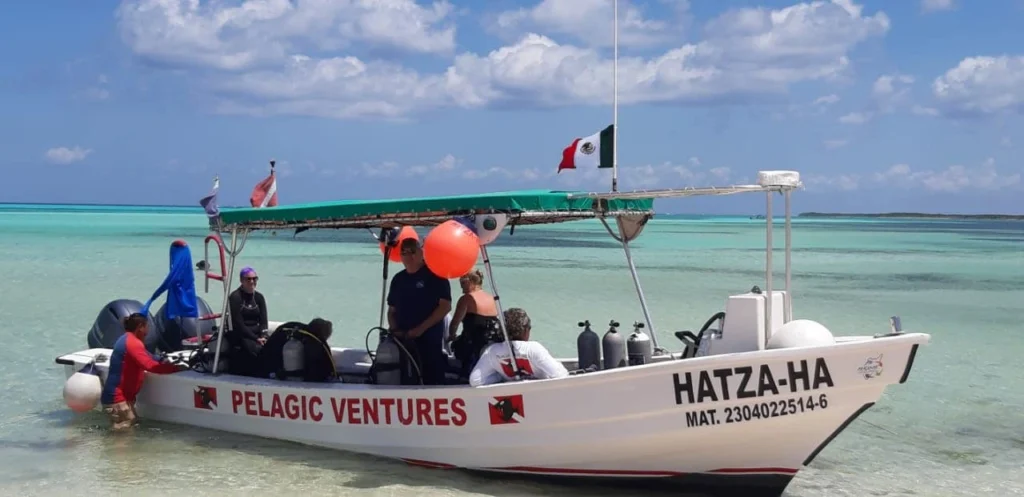
Here in Cozumel, almost every dive boat is a panga, a narrow, low-sided fiberglass fishing boat originally designed for inshore fishing in the Gulf of California. Pangas are fast, maneuverable, and shallow-drafted, which makes them ideal for reaching Cozumel’s reef systems quickly. But they’re also light and responsive to movement, which means weight shifts matter enormously. At Pelagic Ventures, our small-group format (maximum 8 divers per boat) means every diver rolls off with space to spare, no cattle-boat chaos, no gear collisions.
Cozumel’s famous drift diving also shapes how entries happen. Because drift diving in Cozumel often means entering at a specific point and letting the current carry you along the reef, the captain needs divers in the water quickly and efficiently. A smooth, sequential backward roll gets everyone in within 60 seconds. A standing entry would take three times as long and risk missing the current window entirely.
How to Execute a Perfect Backward Roll, Step by Step
If you’re heading to Cozumel for your Open Water certification or returning after a long break, here’s the exact sequence our divemasters walk every student through:
Before You Roll: The Pre-Entry Checklist
- BCD inflated to about 50% (enough to float you immediately after entry)
- Regulator second-stage in your mouth and breathing normally
- Mask on your face, properly sealed, with the strap tightened
- Dive computer active and showing correct depth/time settings
- Fins on both feet, check they’re secure at the heel strap
- Tank valve open (verify with a test breath)
- Visually confirm the water behind you is clear, look over your shoulder
- Wait for the divemaster’s “OK” signal (thumbs up, nod, or verbal “go”)
The 5-Step Back Roll Technique
- Sit on the gunwale, facing inward.
- Place both feet on the outside of the boat, fins hanging over the edge. Shift your weight toward the back edge of the seat. Don’t grip the gunwale, hold your mask instead.
- Place one hand firmly on your mask and regulator.
- Use your palm to press the mask against your face and hold the second-stage regulator mouthpiece in place. This is the single most important hand position in the entire technique.
- Tuck your chin to your chest.
- This protects the back of your head from the tank on entry and directs your body into the proper rotation angle. Don’t look up or to the side.
- Lean back and let gravity do the work.
- Roll backward in one smooth, committed motion. Don’t hesitate, a half-committed roll is more awkward than a confident one. The tank hits first, your body follows.
- Surface, signal “OK,” and clear the area.
- Once you’re in the water and floating, make eye contact with the divemaster or boat captain and give the OK signal (fingertips touching in a circle). Then swim away from the boat immediately to make room for the next diver.
Common Mistakes (And How to Avoid Them)
- Forgetting to hold the mask: The most frequent error. Always prioritize that hand placement, a displaced mask in open water is a minor emergency.
- Hesitating mid-roll: Stopping halfway creates an awkward, uncontrolled fall. Commit fully.
- Not checking behind you: Always look over your shoulder before rolling. Another diver or the propeller could be in the water below.
- BCD fully deflated: You’ll sink below the surface immediately rather than bobbing up. Partial inflation is your friend.
- Sitting too far forward on the gunwale: The rotation needs to start at the edge, not six inches inside it.
Pelagic Ventures Pro Tip: The first backward roll always feels unnatural. By the second or third entry, it becomes second nature. Our divemasters conduct a full briefing before every boat dive, so no first-timer is ever expected to figure this out alone.
Backward Roll vs. Giant Stride, Which Entry Is Right for You?
Backward Roll
- Best for: small boats, RIBs, pangas
- Diver sits on edge, lower center of gravity
- Tank takes water impact first
- Minimal boat rocking
- Efficient for multiple divers in quick succession
- Ideal for Cozumel drift diving
Giant Stride
- Best for: large dive platforms, shore entries
- Diver stands upright, steps forward
- Requires stable, wide platform
- More intuitive for beginners to visualize
- Heavier impact on entry if BCD isn’t inflated
- Common on liveaboards and purpose-built boats
Neither technique is “better” in absolute terms, they’re adapted to different platforms. In Cozumel, the backward roll is the standard because the local panga fleet makes it the logical choice. When you book a boat dive with Pelagic Ventures, your divemaster will confirm which entry technique applies to that day’s conditions before you reach the site.
Pro Tips for Underwater Photographers Rolling Backwards
If you’re diving with an underwater camera housing, a GoPro tray, or a video light rig, the backward roll requires a small adjustment to your pre-entry sequence. Here’s what experienced underwater shooters do:
- Hand off your camera rig before rolling. Pass the rig to a deckhand or your buddy, then complete your back roll. Once you’re in the water and stable, have the rig passed down to you. This is the safest method and is standard practice on professional dive boats.
- If you roll with the camera: Hold the rig tightly against your chest, not out in front of you. The camera should be tucked in, not extended, so it doesn’t catch water resistance and rip from your hand on impact.
- Use a wrist leash: Always connect a safety lanyard from your wrist to the camera handle. A wrist lanyard costs $10 and prevents the loss of a $1,000 housing.
- Check dome port positioning: After your roll, check that no water has gotten under the dome port seal before descending. Surface test, then go.
- Wide-angle housings: The extra size and buoyancy of wide-angle dome ports can shift your center of gravity slightly. Compensate with a touch more BCD inflation before entry.
Ready to Try Your First Backward Roll in Cozumel?
We’ve guided divers through their first backward rolls at Palancar Reef, at Santa Rosa Wall, and dozens of other sites along Cozumel’s protected Mesoamerican Barrier Reef. After 30 years operating out of ASIPONA Marina in San Miguel de Cozumel, our team has watched thousands of nervous first-timers roll backward off our pangas, and surface with the biggest grins in the Caribbean.
What makes the difference isn’t natural ability. It’s a calm, thorough briefing before you ever touch the gunwale. Every diver on a Pelagic Ventures boat hears exactly what to expect before we reach the dive site, hand placement, chin position, the signal to go, and what happens the moment you hit the water. By the time you roll, it’s not a surprise. It’s a plan.
Take the Plunge, We’ll Guide Every Step
Whether you’re brand new to diving or returning after a few years, Pelagic Ventures runs Cozumel’s most personalized small-group dive operation. Maximum 8 divers per boat. Fast pangas. Expert divemasters who remember your name.
Frequently Asked Questions About Scuba Diving Entry Techniques
Does falling backwards off a boat hurt?
No, and this surprises almost every new diver. The scuba tank hits the water first, absorbing the impact before your body follows. As long as your BCD is partially inflated and your mask is held firmly, the entry is surprisingly gentle. Most divers describe it as a quick splash, not a jarring impact.
Will my mask fall off when I roll backwards?
Not if you use proper hand placement. Place one hand flat against your mask with your palm pressing the frame against your face, while your fingers also grip the regulator mouthpiece. This keeps both your mask seal and your air supply secure through the entire rotation and water entry.
What signal does the divemaster give before I roll?
This varies slightly by operator, but most commonly the divemaster will give a verbal “go” or a thumbs-up signal after visually confirming the water behind you is clear. Never roll without a signal. At Pelagic Ventures, every boat entry is individually cleared by the divemaster before each diver goes.
Do all scuba divers use the backward roll?
No, the backward roll is specific to small-boat diving where the diver sits on the edge of the vessel. Shore entries typically use a different technique (walk in backwards with fins on, then flip forward). Large liveaboard platforms commonly use the giant stride. The back roll is the standard for RIBs, Zodiacs, and pangas worldwide.
Can I do a backward roll if I’m afraid of heights or falling?
Most divers with a fear of falling find the backward roll less intimidating than they expect, precisely because you’re sitting down, not standing on the edge. The boat deck is typically only 1–3 feet above the waterline. Your divemaster will brief you fully before you ever sit on the gunwale. Many divers who were terrified beforehand find it the highlight of their first dive day.